
Plot Summary [2]
Part I
Amir, a well-to-do Pashtun boy, and Hassan, a Hazara who is the son of Ali, Amir's father's servant, spend their days in the then peaceful city of Kabul, kite fighting and roaming through the streets. Amir’s father, a wealthy merchant, who Amir affectionately refers to as Baba, loves both the boys, but seems critical of Amir for not being manly enough. Amir secretly believes his father blames him for his mother’s death during childbirth. However, he has a kinder father figure in the form of Rahim Khan, Baba’s friend, who understands Amir better, and is supportive of his interest in writing. Amir tells us that his first word was 'Baba' and Hassan's "Amir,' suggesting that Amir looked up most to Baba, while Hassan looked up to Amir.
Assef, a notorious sociopath and violent older boy with sadistic tendencies, mocks Amir for socializing with a Hazara, which is, according to Assef, an inferior race that should only live in Hazarajat. He prepares to attack Amir with brass knuckles, but Hassan bravely stands up to him, threatening to shoot out Assef's left eye with his slingshot. Assef and his posse back off, but Assef threatens revenge.
Hassan is a successful "kite runner" for Amir, knowing where the kite will land without even watching it. One triumphant day, Amir wins the local tournament, and finally Baba's praise. Hassan runs for the last cut kite, a great trophy, saying to Amir, "For you, a thousand times over." Unfortunately, Hassan runs into Assef and his two friends. Hassan refuses to give up Amir's kite. Amir searches for Hassan but hides when he hears Assef's voice. Assef decides to teach Hassan a lesson by raping him. Amir witnesses the act but is too scared to intervene, and returns home ashamed, guilty for not being able to help his best friend. He feels that his cowardice in Hassan's rape would destroy any hopes for Baba's affections, so he says nothing. Afterwards, Hassan and Amir keep a distance from each other. Amir reacts indifferently because he feels ashamed, and is frustrated by Hassan's saint-like behavior. Already jealous of Baba's love for Hassan, he worries that if Baba knew of Hassan's bravery and his own cowardice, that Baba's love for Hassan would grow even more.
Amir, filled with guilt on his birthday, cannot enjoy his gifts. The only present that does not feel like "blood" money is the notebook to write his stories in given to him by Rahim Khan, his father's friend and the only one Amir felt really understood him.
Amir felt that life would be easier if Hassan was not around, so he planted a watch and some money from his birthday party under Hassan's mattress in hopes that Baba would force him to leave; Hassan falsely confesses when confronted by Baba about the watch and the money. Baba forgives him, despite the fact that, as he explained earlier, he believes that "there is no act more wretched than stealing." Hassan and his father Ali, to Baba's extreme sorrow, leave anyway. Hassan's departure frees Amir of the daily reminder of his cowardice and betrayal, but he still lives in their shadow and his guilt.
Part II
Five years later, the Soviet Union invade Afghanistan. Amir and Baba escape to Peshawar, Pakistan and then to Fremont, California, where Amir and Baba, who lived in luxury in an expensive mansion in Afghanistan, settle in a run-down apartment and Baba begins work at a gas station. Amir eventually takes classes at a local community college to develop his writing skills after graduating from high school at age twenty. Every Sunday, Baba and Amir make extra money selling used goods at a flea market in San Jose. There, Amir meets fellow refugee Soraya Taheri and her family. Soraya's father, General Taheri, once a high-ranking officer in Afghanistan, has contempt for Amir's literary aspiration. Baba is diagnosed with terminal small cell carcinoma but is still capable of granting Amir one last favor: he asks Soraya's father's permission for Amir to marry her. He agrees and the two marry. Shortly thereafter Baba dies. Amir and Soraya settle down in a happy marriage, but to their sorrow learn that they cannot have children.
Amir embarks on a successful career as a novelist. Fifteen years after his wedding, Amir receives a call from Rahim Khan, who is dying from an illness. Rahim Khan asks Amir to come to Peshawar, Pakistan. He enigmatically tells Amir, "There is a way to be good again." Amir goes.
Part III
From Khan, Amir learns the fates of Ali and Hassan. Ali was killed by a land mine. Hassan had a wife named Farzana and a son who he named Sohrab. He had set up a life for himself in a village outside Bamiyan, but returned to Baba’s house as a caretaker at Khan’s request, although he moved to the little hut in the yard so as not to dishonor Amir by taking his place in the house. During his stay, his mother Sanaubar returned after a long search for her son, and died after four years. One month after Khan left for Pakistan, the Taliban ordered Hassan to give up the house and leave, but he refused, and was executed, along with Farzana. Khan reveals that Ali was not really Hassan's father, and that Ali was sterile, and that Hassan was actually the son of Baba, and therefore Amir's half-brother. Finally, Rahim Khan tells Amir that the true reason he has called Amir to Pakistan is to go to Kabul to rescue Hassan's son, Sohrab, from an orphanage.
Khan asks Amir to bring Sohrab to Thomas and Betty Caldwell, who own an orphanage. Amir becomes furious; he feels cheated because he had not known that Hassan was his half-brother. Amir finally relents and decides to go to Kabul to get Sohrab. He storms out of the house in a rage, but later returns and tells Khan will go find Sohrab. He travels in a taxi with an Afghan driver named Farid, a veteran of the war with the Soviets, and stays as a guest at Farid's brother Wahid's house. Farid, initially hostile to Amir, is sympathetic when he hears of Amir's true reason for returning, and offers to accompany him on his journey.
Amir searches for Sohrab at the orphanage. In order to enter Taliban territory, Amir, who is normally clean shaven, wears a fake beard and moustache, to avoid the punishment the Taliban would otherwise deliver. However, Sohrab is not where he was supposed to be: the director of the orphanage tells them that a Taliban official comes often, brings cash, and usually takes a girl back with him. Once in a while however, he takes a boy, recently Sohrab. The director tells Amir to go to a soccer match, where he could see the procurer making speeches at half-time and wearing black sunglasses. Farid manages to secure an appointment with the speaker at his home, by saying that he and Amir have "personal business" with him.
At the house, Amir meets the man, who turns out to be Assef. Assef is aware of Amir's identity from the very beginning, but Amir doesn't recognise his childhood nemesis until Assef starts asking about Ali, Baba, and Hassan. Sohrab is being kept at Assef's home where he is made to dance dressed in women's clothes, and it seems Assef might have been raping him. (Sohrab later confirms this saying, "I'm so dirty and full of sin. The bad man and the other two did things to me.") Assef agrees to relinquish him, but only for a price—cruelly beating Amir. However, Amir is saved when Sohrab uses his slingshot to shoot out Assef's left eye, fulfilling Hassan's threat made many years before.
While at a hospital treating his injuries, Amir asks Farid to find information about Thomas and Betty Caldwell. When Farid returns, he tells Amir that the American couple do not exist.
Amir tells Sohrab of his plans to take him back to America and possibly adopt him, and promises that he will never be sent to an orphanage again. However, US authorities demand, among other things, paperwork as evidence of Sohrab's orphan status. After decades of war, this is all but impossible to get in Afghanistan where, as Amir says, many dead have no certificate just as they had never had a birth certificate. Amir tells Sohrab that he may have to temporarily break his promise until the paperwork is completed. Upon hearing this, Sohrab attempts suicide. Amir eventually manages to take him back to the United States without an orphanage, and introduces him to his wife. However, Sohrab is emotionally damaged and refuses to speak or even glance at Soraya. This continues until his frozen emotions thaw when Amir reminisces about Hassan and kites. Amir shows off some of Hassan’s tricks, and Sohrab begins to interact with Amir again. In the end Sohrab only shows a lopsided smile, but Amir takes to it with all his heart as he runs the kite for Sohrab, saying, "For you, a thousand times over."
Adaptation
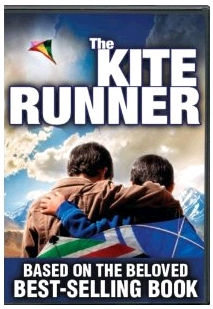
The Kite Runner was adapted into a film of the same name directed by Marc Forster in 2007.
| Share | Tweet |
[1] "Harry Potter tops US best-seller list for 2005". ninemsn.com.au. 2006-01-07.
[2] Wikipedia.org: The Kite Runner

